
Improving Range of Motion with Chiropractic in Colchester
Why movement quietly shrinks over the years, and how to get it back.
By Dr. Christine Lebiecki, D.C. · May 1, 2021
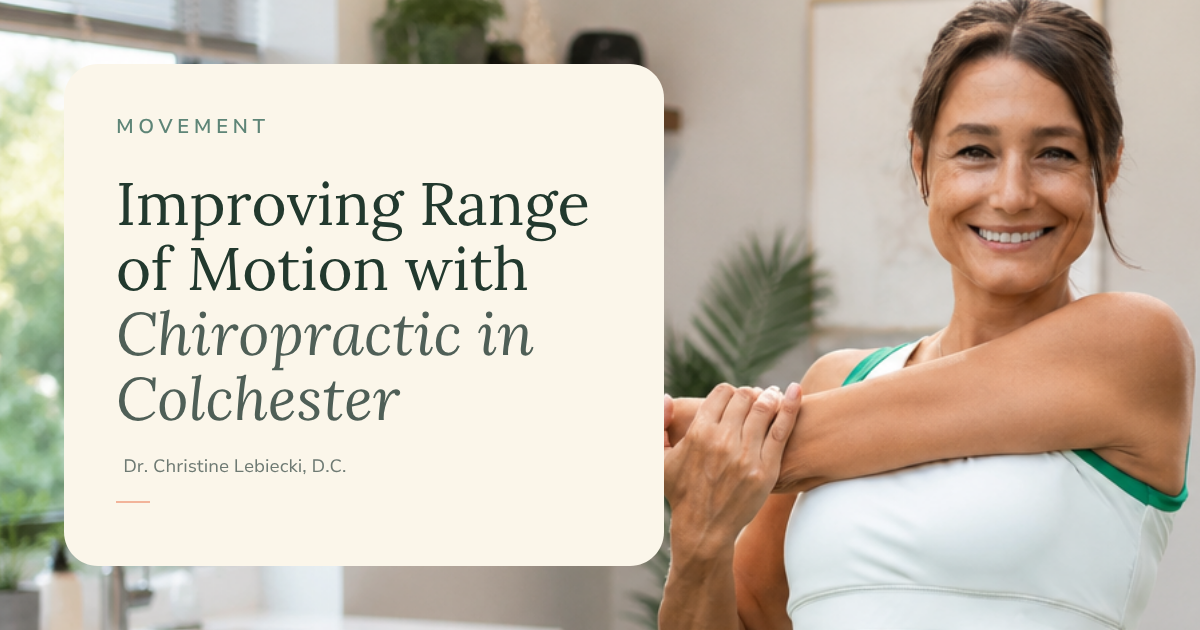
You notice it backing out of the driveway. The shoulder check that used to be nothing now requires turning your whole torso. Or you reach for something on the top shelf and your shoulder stops short of where you expected it to go.
Nobody loses range of motion all at once. It goes a degree at a time, and you adapt so smoothly that you never register the loss until something you used to do without thinking becomes a small production.
The encouraging part: a lot of what you have lost is available to get back.
The Four Reasons Range of Motion Shrinks
It helps to know which one is yours, because they respond to different things.
Disuse. Joints keep the range you regularly ask them to use. Sit for most of your day and your hips stop expecting extension and rotation. The body is efficient. It stops maintaining what it is not asked for.
Guarding after injury. You hurt your low back two years ago. It healed. But the muscles around it learned to brace, and nobody ever told them the emergency was over. Protective muscle tone outlasting the injury is one of the most common reasons motion does not come back on its own.
Joint restriction. Individual spinal segments and other joints can lose their normal glide. The muscles may be fine. The joint itself is simply not moving the way it should, and stretching a muscle does not restore motion at a joint that is stuck.
Fascial change. The connective tissue wrapping your muscles adapts to the positions you hold most. Hold them long enough and that tissue becomes less pliable in the directions you rarely go.
Why the Spine Sets the Ceiling
Your spine has roughly two dozen movable segments, each contributing a small amount of motion. Individually the contributions are tiny. Collectively they determine how you turn, bend and reach.
When several mid back segments stop rotating well, your shoulder has to make up the difference every time you reach behind you. When your hips lose extension, your low back absorbs it with every step. The spot that hurts is often paying for motion that went missing somewhere else, which is why chasing the painful area alone so often disappoints.
Your body does not lose motion randomly. It loses it where you stopped asking, and something else quietly takes over the work.
What an Adjustment Does, and What It Does Not
An adjustment addresses a specific joint that has lost its normal motion. It restores glide at that segment, reduces the reflexive muscle guarding around it, and changes the sensory information that joint is sending back to your nervous system. That last part is why people often feel looser through a whole region after one segment is addressed.
What an adjustment does not do is build capacity. It does not lengthen tissue that has adapted over years, and it does not teach your body to hold and use new range. Opening a door is not the same as walking through it.
That is the job of mobility work, and it is why the two belong together. Adjusting makes range available. Movement makes it yours. Do the first without the second and you will keep returning for the same restriction, because nothing changed the demand that created it.
For the practical side, here is a simple stretching routine you can actually keep up with, rather than a program you abandon by Thursday.
One Thing Worth Ruling Out
Most lost motion is mechanical and unremarkable. But if your restriction comes with numbness, tingling or weakness running into an arm or a leg, that is a different conversation and it deserves a proper examination. The warning signs that point to a disc problem are worth knowing before you start stretching into it.
Getting Your Movement Back in Colchester
At Family First Chiropractic in Colchester, Vermont, an assessment starts with watching how you actually move, not just where it hurts. We find which segments are restricted, which areas are compensating, and where the pattern started. Then we combine care that restores motion with movement you can do at home to keep it.
Age takes some range from all of us. It takes far less than disuse does. If your body has been getting quietly smaller in what it will do, come in and let us find out how much of it is still there.
At Family First Chiropractic our team is here to help. Contact us today.
Or call (802) 860-0382